Bipartisan advocates for smart, sustainable environmental policies in Connecticut


Showing posts with label transportation. Show all posts

Wednesday, August 24, 2011

Connections: Connecticut Wins $15 Million in Federal Transportation Funding

Connecticut won $15.7 million in grants for transportation from the Federal Highway Administration.  On August 17, US Transportation Secretary Ray LaHood announced a new round of federal grants for state transportation projects.  Compared to some of our neighbors, Connecticut fared pretty well this time.  Massachusetts received $6.1 million, Rhode Island received $1.6 million, Vermont received $4.2 million, New York received $16.2 million and New Jersey received $4.5 million.

Two of the projects that will be funded through these grants are for tolling studies-a $1.1 million grant to study congestion pricing for I-95 corridor from New Haven to NY and a $644,000 grant to study "pricing strategies" (i.e., tolls) for I-84 in Hartford related to the rebuilding of the I-84 viaduct.

It was very encouraging to also see a $1.3 million grant awarded to New Britain to implement a complete street strategy for the downtown area.  With the New Britain-Hartford Busway project moving forward this kind of funding is very timely.  Ensuring safe and accessible streets for pedestrians and bikers in the downtown area that connect with the stations for the new bus rapid transit system, will further enhance the community for developers, businesses, residents, and visitors. 

To view the press release and complete list of projects, visit  http://www.fhwa.dot.gov/pressroom/fhwa1137/fhwa1137ct.htm

Kudos to ConnDOT for applying for and receiving these grants!

Tuesday, August 23, 2011

Connections: Putnam Bridge Renovation Offers Great Chance for Walking, Running & Biking Across River

The Putnam Bridge connecting Glastonbury and Wethersfield over the Connecticut River is up for a major renovation providing a golden opportunity to finally add bike lanes and a walkway to this 52- year-old bridge. ConnDOT is planning a $33 million rehabilitation project to fix safety and structural deficiencies with construction starting in 2012 and completed in 2013.  The estimated construction cost of this bridge project is $33 million with 80% coming from federal funding and 20% from state funding.

Historically, there has not been any pedestrian or bike access over the Putnam Bridge but ConnDOT staff, town officials, and bike/pedestrian advocates now are working together to develop a plan for linking the two sides of the Connecticut River for people who want to walk or bike between the two communities.  It would allow people to ride from Somerset Square in Glastonbury to Old Wethersfield town center.  The Putnam Bridge is also a critical piece of a larger bike route for people who want to commute to Hartford by bike.

The town councils in Glastonbury and Wethersfield have unanimously approved resolutions supporting the idea, and support has come from the Capitol Region Council of Governments, Bike Walk CT, Glastonbury Bikeways and Goodwin College in East Hartford.

At recent public meetings, ConnDOT stated that there is limited space and no funds yet allocated for bike/pedestrian access on the Putnam Bridge.  ConnDOT has determined that the rehabilitated bridge can support a six foot wide sidewalk on just one side of the bridge at a construction cost of $5-$10 million.  ConnDOT has informed the towns and public that this amount does not include funding for construction of the town-side approaches to the bridge sidewalk, an undertaking that ConnDOT states is the responsibility of the towns, not the state.  That's troubling to hear when we have a Governor who stresses bike/pedestrian initiatives as a priority for Connecticut's transportation infrastructure and a state legislature that passed the Complete Streets law in 2009 that requires 1% of all new transportation projects to be dedicated to bike/ped improvements.  

Take action and tell the decision makers how you feel.  Their email addresses are:

Connections: State Budget Impact on Transportation Projects Still Uncertain

With the state labor unions voting to accept the concessions package, Connecticut now has a state budget in place.  It is still unclear how transportation funding will shake out.  Governor Malloy's initial budget, Plan A, left most transportation funding intact.  Unfortunately, it seems likely that public transit riders will see fare hikes and/or service cuts.  This is the time when the state should be working to attract more riders; fare hikes and service cuts takes us in the wrong direction and will put more people back in their cars and add more cars to our already congested highways.

ConnDOT is holding a series of six public hearings around the state over the next week about transit fares and services.  The first public hearing is Monday, August 22, in New Britain.  It is important that the public shows up and speaks out to keep public transit in the forefront of the state's transportation priorities for funding.  For a complete list of the public sessions, visit www.ct.gov/dot/farecomments.

To submit your comments by email on the proposals, visit dot.farecomments@ct.gov.

Tuesday, May 10, 2011

CONNECTIONS: Linking Transportation and the Environment in Connecticut: May 9, 2011 Edition

– By Kirsten Griebel

At the LOB

  • Last week the Senate referred Bill 720, the Vulnerable User bill, to the Finance, Revenue and Bonding Committee.  They now have to act on it within seven days (by May 12th) in order to keep it alive.   CTLCV, along with a number of other organizations, has been supporting this bill as it improves safety and encourages pedestrian/bike friendly streets, a tenet of smart growth.  It is currently on the CTLCV legislation watchlist. 

    This bill successfully cleared both the Transportation and Judiciary Committees with the Judiciary Committee voting 41 to 4 in favor.  As a positive for this bill, the fiscal analysis states a potential $75,000 in revenue gain (from new fines), so this is a win – win; a win for the economy and the environment.   Representative Pat Widlitz, a CTLCV environmental champion, is Co-Chair of the Finance Committee and it is our hope she will throw her support behind this bill this week.
  • Governor Malloy and the Bond Commission released $89 million to fund the New Britain-Hartford Busway on April 29th.  This completes the state’s  20% matching funding commitment to the project.  Despite the potential for some very drastic federal transportation budget cuts, the New Starts funding for the NB-H Busway is still intact.  CTLCV joined a broad and diverse group of supporters to thank the Governor for his vision and leadership on this investment in the first new major public transportation project in CT in decades.
Around the State
  • Connecticut’s Complete Streets policy was recently recognized by the National Complete Streets Coalition as one of the top fifteen best Complete Streets policies in the country.  The bill, Public Act 09-154, was authored and championed in the state legislature by former State Representative Tom Kehoe.  Complete Streets and the new Vulnerable User bill make for more liveable cities and towns by making our roads safer for people who are walking or on bikes or other non-motorized transportation.  Safety and accessibility for pedestrians and cyclists is critical to changing Nutmeggers’ mindset of auto dependency and to get out of their cars and try walking or biking as alternatives.  A big part of this is a campaign to educate people about sharing the road and understanding that roads are for all users not just for cars.
  • It looks like the current state budget will put an end to the state subsidy of Dial-A-Ride leaving it up to the municipalities to fund the program.  The budget also decreases municipal matching grants for transit by about $1 million or about 25% of forecasted expenditures.  Otherwise the bus operations budget for the state maintains its current level of funding. Karen Burnaska, Transit for Connecticut, considers this pretty good news given the major budget deficit facing the state.  Maintaining the state’s investment in public transportation is critical for the health of Connecticut’s environment.
Around the Nation
  • Congratulations to the Michigan League of Conservation Voters on their recent success in getting out the vote to approve a bus system expansion in the Grand Rapids region that also includes the first Bus Rapid Transit system in Michigan. The ballot referendum to approve a property tax increase for expanding the region’s bus service passed by only 136 votes out of 34,432 cast! 

    Similar to the New Britain – Hartford Busway, the Michigan Bus Rapid Transit will have a dedicated bus-only lane for about eight miles and may cut travel times in half.  It is part of a larger comprehensive transit strategy that reinforces the need for regions to plan and build multi-modal transportation systems.

    As Ryan Werder, Political Director for Michigan LCV, said “It was an effort that tied us closely with business leaders, non-traditional allies, the mayors of every community involved. With the margin as close as it was, it was the ground game and GOTV work that made the win possible. We are now using this as an opportunity to highlight both the importance of politics in the process of advancing Michigan's environment as well as promoting the common agenda process that identified public transit as a priority.”

Friday, April 29, 2011

New Report Names CT “Complete Streets” Law Among Best in Nation

After months of research and evaluation, the National Complete Streets Coalition has named Connecticut’s Complete Streets law, enacted in 2010, as one of the best in the country.cs-policyanalysis

Championed by former Representative Tom Kehoe, the complete streets law is an important component of smart growth policy, making roads safe and usable for transportation alternatives to the car.  Safe, usable streets make for more livable cities and towns.

The complete streets report, which includes the coalition’s ten elements of an ideal complete streets policy,  is available at http://www.completestreets.org/webdocs/resources/cs-policyanalysis.pdf.

Tuesday, April 26, 2011

CONNECTIONS: Linking Transportation and the Environment in Connecticut

 – by Kirsten Griebel (kirsten.griebel@ctlcv.org)

CTLCV is rolling out a new e-letter called CONNECTIONS: Linking Transportation and the Environment in Connecticut, to provide brief updates on transportation news, issues, policies and legislation that impact your quality of life here in Connecticut.   We welcome your feedback and news tips and hope you find it interesting and informative.

At the LOB

  • Bill 720, Vulnerable Users Bill passed favorably in a 41 to 4 vote in the Judiciary Committee last week and we have high hopes that this is the year for the bill to finally become law.  CTLCV supports this bill as a smart growth bill that makes our roads safer and encourages non-motorized transportation by imposing penalties on drivers that “fail to use due care”.

    A special thanks to Senator Beth Bye who championed this bill, even donning her bike helmet during the Judiciary meeting to reinforce her support.  Thanks also to Judiciary Chairs, Senator Coleman and Rep. Fox for amending the agenda on the final day to place the bill first on the agenda, allowing it to come for a vote before the clock ran out.  Kudos to Bike Walk CT and Tri-State Transportation Campaign for tirelessly working this bill!

    Relevant Facts:
          -     A ‘Vulnerable User’ is a pedestrian, highway worker, person riding or driving an animal, riding a bike, using a wheelchair, skateboard, skates, or riding a farm tractor
          -     ConnDOT 2010 pedestrian accident reports highest number of ped. accidents were in the cities Bridgeport (128)  Hartford (127) Waterbury (105) Stamford (81) New Haven (75).

    This bill does not automatically assume the driver is at fault and does not remove responsibility from the vulnerable user.  State law already has provisions that subject bicyclists and pedestrians to safe use of roads. 
  • Bill 6200, Tolls to build new highways or highway extensions was amended to add “for the purpose of new expansion of Route 11 from Salem to I-95” and approved in the Finance committee this week in a 37 to 15 vote primarily on party lines with the D’s unanimously in favor of it.  There is a need for new sources of revenue dedicated to transportation infrastructure repair and mass transit projects and tolls need to be considered. Projects that involve building new roads or bridges need to be carefully evaluated through a smart growth prism to assess the net environmental benefit.  Both sides of the ‘completing Route 11’ environmental debate need to be heard and CTLCV will work to get that information to you over the next few weeks.

Around the State

  • Office of Fiscal Analysis projects the CT Special Transportation Fund will have a cumulative deficit of $35.1 million by FY 14Yikes!
Around the Nation
  • Transportation for America (www.t4america.org)  reports that there is reason for alarm among transportation advocates as the House approved FY12 GOP budget calls for cuts of $633 billion for transportation over the next ten years.  Read the article “Path to Prosperity or Road to Ruin? Either Way, the House Says Yes” on Streets Blog Capitol Hill here.
  • In CT those cuts could be bad news for the New Haven-Hartford-Springfield rail line project which is waiting for an additional $227 million in federal funding.  The federal New Starts funding for the New Britain-Hartford Bus Rapid Transit project however looks to be intact and especially promising as this project is considered shovel-ready for late spring or early summer this year. The busway is a win for the environment with an expected daily ridership of 16,000 people and decreasing road congestion and a win for the economy with an expected creation of 12,000 construction related jobs.

Wednesday, April 13, 2011

So Where Does This Leave CT High Speed Rail?

The CT Mirror's Washington reporter, Deirdre Shesgreen covers the eye-opening news of what the federal spending deal, reached by top congressional negotiators on Friday to avert a government shutdown, actually means.

Among other things,”it would slash high-speed rail funding… including a $2.9 billion cut in high-speed rail dollars” which Congressman Joe Courtney calls "counterproductive" for the economy in general and for Connecticut in particular.

“The high-speed rail provision includes a $400 million rescission from the $2.4 billion pot of money Florida's governor rejected earlier this year. Connecticut has applied for $227 million of that money for its proposed New Haven-to-Springfield line, but so have two dozen other states. They will all now be competing for part of a smaller pie, if this spending agreement is approved.”

The $40 million funding just wrapped up last week for double-tracking part of the New Haven – Springfield line is a separate award that appears to be unaffected by the federal spending agreement.

See Budget deal is a mixed bag for Connecticut, by Deirdre Shesgreen for the CT Mirror.

Wednesday, March 30, 2011

Connecticut’s Bridges: Are Yours Safe?

If being stuck in traffic atop a bridge has ever made you shudder, Transportation for America’s new report on the condition of our nation’s bridges assures that your fears are not necessarily exaggerated.

The Fix We’re In: The State of Our Nation’s Bridges is one report you’re going to want to look at.  And you might want to plot a detour for your daily commute after entering your address at http://t4america.org/resources/bridges/ to see which bridges near you are structurally deficient. (Scroll down below for maps of structurally deficient bridges in the Hartford and Stamford areas.  Quick tip:  red bridge = bad.) 

image

“The Fix We’re In” finds that  69,223 bridges – representing more than 11 percent of all U.S. highway bridges – are classified as “structurally deficient,” requiring significant maintenance, rehabilitation or replacement.  The report also features an interactive online map allowing readers to see all the bridges, including structurally deficient bridges, within a ten-mile radius of any US address that is entered. Structurally deficient bridges appear as red icons. Clicking on any bridge provides more details on it, including its safety rating.

4.5 Million Trips Per Day Made Across Connecticut’s Deficient Bridges
Pennsylvania ranked first as the state with the greatest percentage of structurally deficient bridges, and Nevada ranked last as the state with the lowest such percentage. California, however, ranks first as the state with the most daily traffic traveling over structurally deficient bridges, at a total of 82.6 million trips per day.

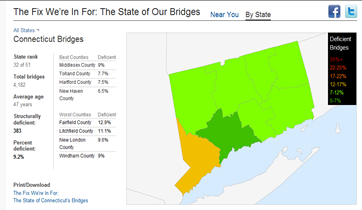
While Connecticut’s 32nd place rank in the bad bridges category is not bad compared to other states, that’s not saying much.  As of 2010, 9.2% (383) of Connecticut’s 4,182 highway bridges were structurally deficient. Relatively speaking that may not seem so bad, except that those structurally deficient bridges carry a total of almost 4.5 million vehicles every day – one of which might be yours.

Investments in Bridge Upkeep
Connecticut’s record for investing its federal transportation funds on bridge upkeep is also not bad in comparison to other states’ records.  In 2008, all states spent $8.1 billion of federal funds
on repair and rehabilitation of bridges, or about 13 percent of total funds. In 2008, Connecticut
spent $111 million, or 21.0 percent of total federal funds, on bridge upkeep. 

Sealing the Case for “Fix it First”

“Fix it First” is an approach that invests in infrastructure repair and preventive maintenance before building new roads or expanding existing roads.  The theory is that if you can’t afford to fix what you have, you have no business building more of what you can’t maintain.

Moreover, most bridges are designed to last for 50 years.  According to the Transportation for America report, 1775 of Connecticut’s 4182 bridges are more than 50 years old, with the average age of  Connecticut’s bridges at 47.2 years. 

Connecticut’s rank among other states notwithstanding, the vast numbers of people traveling over the state’s deficient bridges every day combined with the number of its bridges nearing the end of their 50-year lifespan, make an indisputable case for adopting a much more robust “Fix it First” approach to managing the state’s infrastructure. 

Tell your US Senators and Congressmen and women, and tell your state legislators that after decades of deferring maintenance on our bridges, it’s time to pay the piper:  safe bridges are essential.

Two Examples:  Structurally Deficient Bridges in Stamford and Hartford Areas

Fairfield County is home to the greatest percentage of Connecticut’s structurally deficient bridges, a fact that is explained—and compounded—by high traffic volume, with nearly 1.4 million vehicles traveling over structurally deficient bridges each day

Structurally Deficient Bridge Locations in Stamford Area

image

Structurally Deficient Bridge Locations in Greater Hartford

image

For more information, see:

Friday, March 18, 2011

How Busway & Commuter Rail Will Serve Central Connecticut

With the federal government on the brink of awarding eighty percent of the funding to build the New Britain-Hartford Busway, the Regional Plan Association (RPA) explains how the Busway and Commuter Rail will work together to serve New Britain and Bristol and how rail services can be added to the region as demand for transit grows. 

Watch the video, then read more here.

Saturday, February 12, 2011

Bus Rapid Transit Makes for a World’s “Most Visionary City”

Travel + Leisure magazine’s recent feature on the “The World’s Most Visionary Cities” put Curitiba, Brazil on the list for its Bus Rapid Transit system.

In most metropolises, walking is faster than taking the crosstown public bus. Not so in Curitiba. In the 1960s, city planners examined their growing town and, to curtail congestion, implemented a comprehensive public-transportation scheme: Bus Rapid Transit. To speed up loading of the long, centipede-like buses, passengers—more than 80 percent of the population—pay low-cost fares beforehand (about 40 cents a ride, with unlimited transfers). The frequently arriving fleet speeds down dedicated streets unimpeded.

It's often cited as the ideal public transport system.

Curitiba, Brazil Public Transportation


Other cities make the list for green reasons, like urban farming, bike-share programs, and electric vehicle charging stations.

The proposed Hartford-New Britain busway would include bus rapid transit.

More at:  http://www.travelandleisure.com/articles/worlds-most-visionary-cities

Friday, February 4, 2011

Research Confirms President Obama's SOTU Remarks: Smart Transportation Spending Creates Jobs, Grows the Economy

clip_image002 clip_image002[4] clip_image002[6]

FOR IMMEDIATE RELEASE: February 4, 2011

Susan Merrow, Chair, 1000 Friends of Connecticut
860-367-1687, amerrow@snet.net

Kirsten Griebel, CTLCV Education Fund
860-670-0621, 860-236-5442, kirsten.griebel@ctlcv.org

Alex Goldschmidt, Smart Growth America
202-207-3355 x112, agoldschmidt@smartgrowthamerica.org


CT Ranks First in report that shows investing in repair and maintenance projects and public transportation can help Connecticut revitalize America's transportation system and rebuild the economy.

Connecticut, February 4, 2011 - A new report released by Smart Growth America (SGA) provides Connecticut with a roadmap to pursue President Obama's call to repair our crumbling roads and bridges and invest in public transportation to jumpstart the economy. The report, which highlights how well states created jobs using American sga reportRecovery and Reinvestment Act (ARRA) flexible transportation dollars, provides Governor Malloy, the Department of Transportation, and the legislature with a smart investment strategy to get more jobs from the same number of transportation dollars and help rebuild the economy effectively.

Connecticut ranked first, based on how well we used our portion of the $26.6 billion in flexible ARRA transportation dollars to create jobs. The report was released two years after the passage of ARRA and a week after President Obama's State of the Union Address and his clarion call to rebuild America and create jobs.

"Smart Growth America commends Connecticut for using its federal stimulus funding to maximize job creation," Geoff Anderson, President/CEO of Smart Growth America said. "Connecticut should continue on this same path of smart, fiscally responsible transportation policies when it considers its 2011 transportation budget. If Connecticut continues to allocate the majority of its transportation dollars in its new budget to the repair and maintenance of roads and bridges, and expanding access to public transportation, the state can save money and put people back to work."

Connecticut leaders understand that rebuilding our economy is the most significant challenge of our generation. As the President said in his address, "To attract new businesses to our shores, we need the fastest, most reliable ways to move people, goods and information...America is the nation that built the transcontinental railroad, brought electricity to rural communities and constructed the interstate highway system. The jobs created by these projects didn't just come from laying down tracks or pavement. They came from businesses that opened near a town's new train station or the new off-ramp." This report analyzes state-reported ARRA data and finds that wise spending of transportation dollars produces immediate results in terms of jobs.

The states that made the best use of funds invested in public transportation projects and maintained and repaired existing roads and bridges. The states that ranked poorly focused on building new roads and bridges.

Connecticut spent 100 percent of its ARRA transportation funds on repairing and maintaining roads and bridges; nothing on building new ones; and 9.1 percent on public transportation and non-motorized projects such as trails, bicycle projects and pedestrian projects.

"We're proud that Connecticut "fixed it first" and created jobs critical to our state's recovery. We urge even greater emphasis on mass transit funding, which has a triple benefit: it creates jobs, gets people to their jobs, and improves the quality of life for all of us," said 1000 Friends of Connecticut Chair and CTLCV Director Susan Merrow.

. . . . .

"We have seen a gradual shift in Connecticut toward investments in public transit where we get the biggest bang for the buck - dollar for dollar, public transportation projects create the highest percentage of jobs. These investments are good for both the economy and the environment," added Lori Brown, Executive Director of the Connecticut League of Conservation Voters.

SGA determined its rankings by assessing how states invested their ARRA flexible transportation dollars, as reported by the states themselves to Congress.

Historically, repair work on roads and bridges generates 16 percent more jobs per dollar than new bridge and road construction. Repair and maintenance projects spend money faster and create jobs more quickly than building new roads because they employ more kinds of workers, spend less money on land and more on wages, and spend less time on plans and permits.

Additionally, historical investments in public transportation have generated 31 percent more jobs per dollar than new construction of roads and bridges. SGA's analysis of ARRA spending shows that even more jobs were created with public transportation spending - these projects generated 70 percent more jobs per dollar than new highway construction.

"Our new administration in Hartford and new leadership at Department Of Transportation have a chance now to build on this good news and firmly establish the connection between wise spending on transit, fixing existing infrastructure, and growing smart," Merrow concluded.


For the complete report, go to http://smartgrowthamerica.org/documents/lessons-from-the-stimulus.pdf.


Smart Growth America is the only national organization dedicated to researching, advocating for and leading coalitions to bring smart growth practices to more communities nationwide. From providing more sidewalks to ensuring more homes are built near public transit or that productive farms remain a part of our communities, smart growth helps make sure people across the nation can live in great neighborhoods. For additional information, please visit www.smartgrowthamerica.org.

###

Thursday, February 3, 2011

A Fiscal Conservative, Congressional Transportation Committee Chair Mica Sees Transit as Efficient Investment

Could the tides be turning on high speed rail?

Our partner, Transportation for America, reports that Florida Republican John Mica could be a key ally on high-speed rail.

T4America turned up this impressive 2009 statement from Mica:

“If you’re on the Transportation Committee long enough, even if you’re a fiscal conservative, which I consider myself to be, you quickly see the benefits of transportation investment. Simply, I became a mass transit fan because it’s so much more cost effective than building a highway. Also, it’s good for energy, it’s good for the environment – and that’s why I like it.”

Read the full T4America article here:  Florida Republican John Mica could be a key ally on high-speed rail.

Because of its impact on climate change, greenhouse gas pollution, energy security, sprawl, public health and the nascent green jobs sector, promoting sustainable transportation options is one of CTLCV’s current focus areas.

Saturday, January 29, 2011

Malloy Looks to Complete Route 11

The New London Day's new political reporter, Matthew Collette, who succeeds Ted Mann, reports that the Route 11 project appears to be moving toward the Malloy administration’s front burner.

As a general principle, advocates for sustainability take the position that spending our exceedingly limited funds on building new roads is exactly the wrong route to a sustainable, competitive green economy. Governor Malloy has tended to subscribe to this notion.

In the business world, we talk about "making the business case" for doing project x, y or z. As a parallel, what's the sustainability business case for proceeding with expanding Route 11?  Are decision makers using a common set of criteria to make go/no-go decisions on transportation projects? If so, what are they?

What do you think?  What's the sustainability business case for expanding Route 11?

Here are some criteria by which we might evaluate projects going forward.  Will the project:

  • Resolve safety problems?
  • Create viable alternatives to driving?
  • Reduce VMT (vehicle miles traveled)?
  • Reduce greenhouse gas pollution?
  • Discourage sprawl?
  • Avoid runoff pollution?
  • Induce transit-oriented development?
  • Create long-term good, green jobs?
  • Reduce congestion? 
  • Create some other quantifiable benefit that exceeds that cost?

Our partner, Transportation for America has a good set of similar performance objectives here.  The site at http://www.nycroads.com/roads/CT-11/ makes for interesting reading, discussing the Route 11 Greenway concept that was funded in 2003.

What do you think?  What's the sustainability business case for expanding Route 11?  Let’s hear it.

Friday, January 28, 2011

New Haven – Hartford – Springfield rail line gets regional support. “A win-win-win for the economy, the environment, and jobs”

By Kirsten Griebel

January 28, 2011, 10:00 AM, Union Station, Hartford, CT

Four members of CT’s congressional delegation, Congressman Larson, Courtney, Murphy and Congresswoman DeLauro, CT Governor Malloy, and Senator Blumenthal held a joint meeting with PA Congressman Bill Shuster, and MA Congressman John Olver and DOT reps from MA and VT, to champion the development of the Northeast Rail Corridor and specifically the New Haven – Hartford – Springfield rail line.  This rail line presents a unique opportunity for CT, one that unites a number of different stakeholders, political, business and environmental, in support of a major transportation project, that will benefit the environment and the economy while simultaneously create jobs.

Congressman Shuster, Chair, Sub-Committee on Rail, US House of Representatives Transportation Committee, said the investment in rail is critical to the nation and in particular to the NE corridor. The NE has the population and the congestion, both on roads and in air.  70% of delayed flights nationally originate in the NE airports causing a negative ripple effect on the rest of the nation. Shuster noted that President Obama said in his recent State of the Union address that his goal is to get rail to 80% of the nation. Today, Shuster said we could get rail to 20% of the country by developing the NE corridor rail line. He also said that FLA Congressman John Mica, Chair of the Transportation Committee is “fully committed” to the NE corridor.  And he said President Obama indicated he wants “robust rail” included in the Highway Re-Authorization Bill which will be coming in late spring.

Governor Malloy said his top two goals were to reduce energy rates in CT and to improve the ability to move people and freight efficiently through the state.  He said “to compete with emerging economies” transportation is the “most strategic investment we can make” and he pledged to work hard to secure federal monies to make the New Haven- Hartford-Springfield rail line a reality. He also stressed the importance of connecting CT to NY, MA and VT saying he will work with the Governors of those states on regional transportation  initiatives.

Governor Malloy stated clearly that CT needs to stop borrowing to pay for operating expenses but that it is appropriate to borrow for infrastructure such as transportation projects and to leverage federal investments.  He will be more specific about how to pay for these investments in his upcoming “economic blueprint” - his budget proposal on Feb. 16.

Congresswoman DeLauro said high speed rail is desperately needed in the NE corridor and the NH-H-S line is the “top priority” of the CT delegation.  She stressed that high speed rail is an economic driver and is one of the best job creators.  Rail projects as a job creator was consistently echoed by all speakers. 

Congressman Courtney spoke of the challenges of CT’s 100 y.o. draw bridges as an impediment to high speed rail.  CT received ARRA  federal monies to repair the Niantic River draw bridge which will not only improve rail service but also create construction jobs.

Congressman Murphy focused on the opportunity for transit oriented development, citing the Meriden rail station and surrounding area as a good example of TOD just waiting to happen once the rail line is complete.  He went on to say that the rail branch lines to Danbury and Waterbury, have been underfunded and underutilized as the state has had to direct rail funding to the main rail lines.  With federal funding of the main rail lines, CT may be in a position to re-direct funds to develop the branch lines and help move people out of cars and on to rail.

Speaker of the House, Chris Donovan, said that the NH-H-S rail line is “an opportunity to preserve the rural areas in CT while revitalizing our urban areas”.

Senator Blumenthal summed it up saying rail projects are a win-win for the economy, the environment and job creation and that he will fight for federal transportation funding for CT.

For reports and agenda presented at today’s joint meeting go to:

Thursday, January 13, 2011

Stalled: Fed Funding for Transit & Highway Projects

The Highway Trust Fund, which provides about $41 billion annually to the states for transit and highway projects each year, has been without a funding plan for more than 15 months, and now House Republicans want to appropriate funding for it on an annual basis.

Through legislation, Congress has historically allocated money to the fund for a period of j0442844years, instead of through an annual appropriations process, because transportation projects are long term endeavors that need stable, predictable funding.

Senator Chris Dodd championed a National Infrastructure Bank concept that would have created a pool of public and private funds for critical, high priority transportation projects.  But with Dodd out of office, new, persuasive champions need to be recruited for that initiative to go anywhere. Massachusetts Senator John Kerry seems to be stepping up to the plate, with his call for the US to keep pace with the rest of the world or get left behind. 

Meanwhile, until we get our House in order, the public’s call to create jobs, shore up our infrastructure and build transit systems that get us out of our cars goes ignored.

Read more at:

Tuesday, December 28, 2010

How To Pay For Transit

How To Pay For Transit? The Hartford Courant

The state must have a first-class transportation system for the 21st century, and must find a way to pay for it. If Governor Malloy and the legislature can stabilize transportation funding, the goal then would be to keep moving toward a balanced, multimodal system of transportation.

Read the complete editorial here:

http://www.courant.com/news/opinion/editorials/hc-ed-agenda-transportation-1228-20101228,0,7821451.story

Monday, October 25, 2010

CT to Get Major Fed Investment for High Speed Rail

FOR IMMEDIATE RELEASE

October 25, 2010

Contact: Caren Auchman

202-747-4973

or

Rebecca Kaplan

860-383-6362


DODD, GOVERNOR RELL, CONNECTICUT CONGRESSIONAL DELEGATION TO ANNOUNCE MAJOR FEDERAL INVESTMENT IN HIGH-SPEED RAIL


WASHINGTON, D.C. — On Monday, Senator Chris Dodd (D-CT) will be joined by Governor Rell, Congresswoman Rosa DeLauro (CT-3), Congressman John Larson (CT-1) and Congressman Chris Murphy (CT-5) to announce a major federal investment in the high-speed rail connecting New Haven, Hartford and Springfield, MA at the Amtrak Station in Meriden.


This funding from the Department of Transportation (DOT) will be added to the $260 million that the State Bond Commission has approved to help finance the project and will be used to establish faster, more frequent intercity and commuter rail service and encourage transit-oriented development throughout central Connecticut.


As the Chairman of the Senate Committee on Banking, Housing and Urban Affairs, which has jurisdiction over public transportation, Dodd has been a longtime advocate for high speed rail service in Connecticut. Dodd, DOT Secretary LaHood, Connecticut’s Congressional Delegation, Governor Rell, and state officials have been working together to deliver federal funds to Connecticut to complete the Tri-City Corridor that will provide residents of central Connecticut with better access to New York City, western Massachusetts, Vermont, and eventually Boston.


WHO: Senator Chris Dodd

Governor Rell

Congresswoman Rosa DeLauro

Congressman John Larson

Congressman Chris Murphy

Speaker Chris Donovan

ConnDOT Commissioner Jeff Parker


WHERE: Meriden Amtrak Station

60 State Street

Meriden, CT


WHEN: MONDAY, October 25, 2010

3:00 p.m.

###

Wednesday, July 14, 2010

It’s Time to Speak Up for Clean Transportation

Transportation for America reports that Majority Leader Harry Reid is making it his priority to pull together climate legislationimage this week.  He will be meeting with a group of committee chairs, and then Senate Energy and Natural Resources Committee will be marking up an assortment of energy bills at the end of the week. 

Initial reports suggest the final package will scaled back, and there is a chance the clean transportation provisions from the Kerry Lieberman bill won't make the cut. 

Please call your Senators today and tell them that reducing emissions from transportation is crucial.  Ask them to call Senator Reid in support of clean transportation.  Click here for links to Connecticut’s Congressional Delegation on www.vote-smart.org.   

Not from Connecticut?  Click here and choose your state:  http://www.vote-smart.org/official_congress.php.

Thursday, July 1, 2010

Take the Train to Yankee Stadium

-by Michael Wysolmerski, Summer Intern from Yale,

michael.wysolmerski@ctlcv.org

Since last year’s opening of the new Yankee Stadium, Metro-North’s “Take the Train to the GameTM” service offers Connecticut Yankee fans the opportunity to skip the hassle
of driving to and parking at the Stadium, allowing them help cut down on vehicle miles traveled as well. Fans can take a direct “Yankee Clipper” train for all weekday 7:05 p.m. games from New Haven at 4:15 p.m. that arrives at the 153rd Street Yankee Stadium stop at 5:50. Trains run for all regular season weekend and holiday games as well. Direct trains from the Stadium to Connecticut start to depart 20 minutes after the final out, with the final one leaving 45 minutes after the game. In addition, shuttles from Grand Central and the Harlem-125th Street stations, both stops on the normal New Haven-Grand Central lines, are available to the Stadium. The train provides a comfortable, worry-free, and environmentally friendly route to the stadium—one that all Yankee fans traveling to the Stadium should check out!
For more information on the Yankee train, click here and here. For a pdf of the schedule, click here.

Tuesday, June 29, 2010

More Transit Cuts Coming, Unless Public Transportation Preservation Act Intervenes

– By Michael Wysolmerski, Summer Intern from Yale, 
michael.wysolmerski@ctlcv.org

Just last week, the New York Daily News reported that the MTA has cut the Metro-North 1:34 p.m. express from Grand Central to New Haven, the 2:33 express from New Haven, and the 1:15 a.m. train from Grand Central to Stamford—even though Connecticut, according to a Hartford Courant article, will pay $200,000 to avoid further Metro-North cuts in the state.

The federal Public Transportation Preservation Act (S 3412/HR 5418) could come to the rescue. The bill, which was introduced by Senators Chuck Schumer, Kirsten Gillibrand, Frank Lautenberg, Robert Menendez, and Chris Dodd, would provide $2 billion in federal aid to transit agencies across the country that are cutting service and raising fares.

The Public Transportation Preservation Act, according to a press release on Senator Schumer’s (D-NY) website, would provide approximately $345 million for the NYC-NJ-CT urbanized area, which includes southwestern Connecticut, and prevent cuts and higher prices on the Metro North Railroad. More specifically for Connecticut, according to calculations done by Michelle Ernst, TSTC’s staff-analyst, the Connecticut Department of Transportation stands to receive approximately $36 million, while other Connecticut transportation agencies would receive around $2 million, bringing the total funding to the state to around $37 or $38 million.

According to TSTC, the money from the bill could only be put towards transit operations. No capital construction projects could receive funding.

Not only would the bill help preserve public transportation systems, but it would create approximately 72,000 high quality green jobs, according to figures from the American Public Transportation Association.

The bill is rapidly gaining momentum in the Senate, as it now has 11 co-sponsors, yet there are currently only two co-sponsors in the House. According to the TSTC, New York advocates of the bill are urging their representatives to co-sponsor the bill in the House.

Transportation for America urges voters to “keep flooding our senators with letters and calls,” and released an action alert that calls for senators to cosponsor the bill.

Click here to tell your senators to support emergency transit funding and keep America's transit systems running.